

Part 3/3 – Maturity, Practical Framework, and FAQ
In Part 1, you learned the potential: six use cases generating 35-50% ROI. In Part 2, you understood LATAM’s unique challenges and why governance is critical.
Now comes the practical question everyone asks: where do I start?
This Part 3 provides exactly that: a clear maturity assessment, a step-by-step framework to start in weeks (not years), and answers to the questions CTOs and CEOs really ask when considering AI investment.
How to Assess if Your Bank is Ready for Generative AI
Before starting any artificial intelligence implementation at your bank, an honest assessment of organizational readiness is essential. Not to decide whether to implement — the answer to that question is yes — but to understand how much preparatory work the implementation requires.
The Five Assessment Dimensions
1. Data Maturity
If the same customer’s data differs across your core banking system, CRM, and customer service system, you have a problem to solve first. You don’t need perfect data to start — but you need to know where it is and what quality it has.
Ask Yourself:
- Is there a single source of truth for customer data?
- What percentage of critical fields has real, current values?
- Is there sufficient historical data for the use cases that interest me?
2. Technology Readiness
If it takes more than 3 months to get something to production from the decision point, your IT operating model needs adjustment before you attempt agile AI implementations.
Ask Yourself:
- Do you have APIs or is every integration a months-long project?
- What proportion of your systems is legacy?
- How long does a technology change really take from end to end?
3. Talent and Organization
If AI is perceived as a “systems department thing,” success probability drops drastically. Projects that work have business leaders involved from day one.
Ask Yourself:
- Do business leaders participate in technology decisions?
- Is there tolerance for controlled error?
- Are sales teams open to working with AI tools?
4. Governance and Compliance
This is the most ignored and most dangerous dimension to ignore. A compliance incident in the first 6 months can freeze your entire AI agenda for 12-18 months.
Ask Yourself:
- Is there a formal approval process for AI projects?
- Have you conducted a compliance assessment with your country’s regulation?
- Can you generate audit trails of automated decisions?
If the answer to all three is no, that’s your first project — not for abstract regulation, but for practical survival.
5. Strategic Clarity
“We want to use AI” isn’t a strategy. It’s an intention. And it’s the most common starting point of projects that go nowhere.
Ask Yourself:
- Is there a specific business problem I want to solve?
- Is there real executive alignment — not just statements — on priority?
- Do I have success metrics defined?
The Quick Diagnosis
Yes to Almost Everything: You can start in 4-8 weeks.
No to Data or Technology: There’s foundational work, but don’t stop. Choose a first project that works with what you have while you improve your foundation.
No to Governance: Start there. Before any model, before any chatbot. Because the cost of an early compliance incident is infinitely greater than the cost of preparing.
Where to Start: A Practical Framework
Step 1: Choose Your First Use Case Well (Week 1-2)
Your first project needs to accomplish three things simultaneously:
- Visible impact in 30-60 days
- Containable risk if something fails
- Data available with your current infrastructure
For most LATAM banks, the two best options are: customer service chatbot for frequent inquiries, or AI copilot for the sales team. Quick return, manageable risk, don’t require perfect architecture.
Step 2: Minimum Viable Governance (Week 1-4, in parallel)
You don’t need a complete governance framework. You need three things:
- An AI owner with real authority — can be part of the CTO or CDO role
- A simple approval process — not bureaucratic, but existing
- Use case documentation — what data it uses, what it decides, what its limits are
The minimum that protects you if the regulator asks.
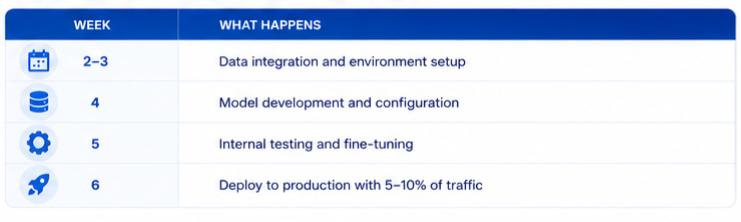
Step 3: Implement (Week 2-6)
Step 4: Measure, Learn, Scale (Week 6-12)
First results are data, not verdict. Three questions:
- Did the primary metric improve?
- Were there incidents?
- Did the team gain confidence?
If answers are yes, no, yes — scale and design your second use case.
The Most Important Rule: Starting small isn’t lack of ambition. It’s tactical intelligence. Institutions that try to transform everything at once usually transform nothing. Those who choose one case, execute it well, and scale with confidence — those have 5 projects in production in 18 months.
The 8 Questions Everyone Asks
1. How Much Does It Cost?
- First project: USD 50k-150k
- Average implementation: USD 150k-300k
- Complete transformation: USD 500k-2M+
For a mid-sized LATAM bank, the first project typically costs USD 100k-200k with payback in 4-8 months.
2. What’s the Real ROI of a Chatbot?
- 40-55% fewer tickets requiring humans
- CSAT increases 15-25 points
- Cost per interaction: USD 0.001-0.005 vs. USD 2-4 per agent
- Payback in 3-6 months
3. What Regulation Applies to Me?
- Brazil: LGPD (strict, GDPR-like)
- Mexico: LFPDPPP + CNBV (flexible, with sandboxes)
- Argentina: PDPA + BCRA (conservative, mandatory notification)
- Colombia and Chile: Progressive regulators
Conduct a country-specific assessment before you start.
4. Is AI-Based Scoring Legal in Argentina?
Yes, with restrictions: Central Bank notification, auditable documentation, customer right to human review, and frequent retraining due to macro volatility. Consult compliance before implementing.
5. How Long Does It Take?
- Simple chatbot: 4-8 weeks
- Sales copilot: 6-12 weeks
- Credit scoring: 12-16 weeks
- Multi-use case transformation: 12-18 months
If your first project takes longer than 12 weeks, your scope was poorly defined.
6. Can Compliance Wait?
No. An incident in the first 6 months can paralyze everything for 12-18 months. Establish the minimum before you start, not after.
7. Do I Need Data Scientists?
Not necessarily. Modern platforms are designed for business users. What you really need: an AI owner, technical team for integrations, and clear governance.
8. What Happens If We Do Nothing?
- In 12 months your competition will have 1-2 use cases running
- In 24 months the efficiency gap will be visible in your numbers
- In 36 months you’ll be acquisition target for the competitor who modernized
The Window Is Closing
The question is no longer whether to implement AI. It’s whether you do it now — or after your competition does.
Those who close the gap between intention and execution in the next 12-18 months will have:
- Models trained on your data
- Teams that know how to use AI
- Accumulated regulatory trust
- Customers accustomed to experiences that laggards won’t be able to offer
In 36 months, that will be the difference between leadership and obsolescence.


