

Agentic AI and Stablecoins Are Rewriting the Bank’s Perimeter: Seven Reports to Read Together
The reports that landed this week share a common underlying thesis. The conversation about artificial intelligence in financial services has left pilot territory and settled into the domains of scale, governance and cost structure. In parallel, digital payments continue eroding the bank’s monopoly over money movement, with stablecoins, instant payments and digital remittances displacing volumes that two years ago were considered marginal.
Reading the seven pieces together, a shared diagnosis emerges. First, agentic AI is no longer a laboratory curiosity and has become a vector for cost and operating model reconfiguration. Second, the bank’s balance sheet faces direct competition from three simultaneous fronts: fintechs with expanded offerings, stablecoins as a parallel value rail and private credit as a funding alternative. Third, adoption speed is visibly bifurcating between leaders and laggards, with return differences that are already material to shareholders.
This digest assembles the seven reports published in recent days and organizes them around four vectors: governance, competitive model, operating economics and financial inclusion in emerging markets.
State of AI Trust 2026 — McKinsey
Access the full report: State of AI trust in 2026: Shifting to the agentic era
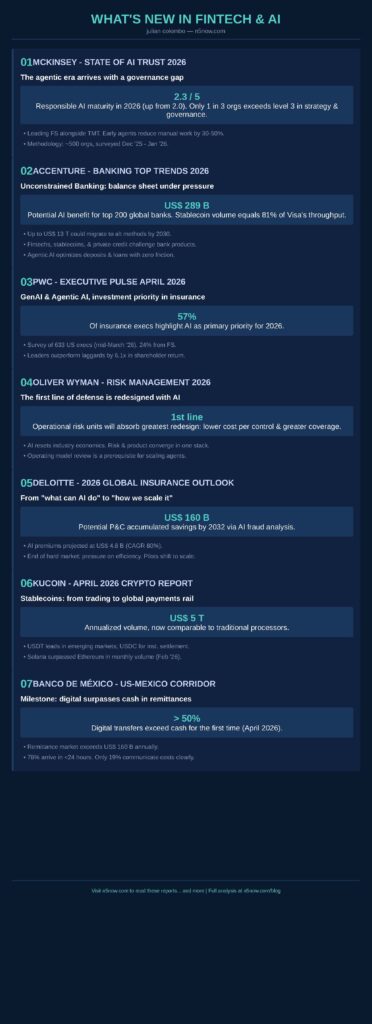
McKinsey’s responsible AI maturity survey covered roughly 500 organizations between December 2025 and January 2026. The average score rose to 2.3 out of 5, up from 2.0 the prior year. The improvement is real but modest, and only a third of respondents reach level 3 or higher on strategy, governance and agentic-AI governance. The report identifies financial services and TMT as the two sectors with the highest maturity, leveraging pre-existing risk-management practices and more consolidated data foundations.
The conceptual inflection point in the report is clear. In traditional generative AI, the concern concentrated on the system saying something incorrect. In the agentic world, the concern extends to the system doing something incorrect: taking unintended actions, using tools beyond its authorized scope or operating outside the defined guardrails. This difference forces control frameworks to extend from linguistic territory into transactional territory.
The operating impact data point is relevant. Early agent deployments report 30% to 50% reductions in manual load within narrow processes, and project the possibility of zero-touch operations in segments such as onboarding, reconciliation and transactional customer service. That magnitude changes the return conversation, because the discussion is no longer about incremental productivity but about reallocating entire functions.
The implication for the industry is that the bottleneck is no longer technological but control-related. Organizations that can audit actions, trace behavior and contain risk with the same rigor they apply today to human operations will be able to scale agents. Those that cannot will remain anchored in indefinite pilots.
Banking Top Trends 2026 — Accenture
Access the full report: Top Banking Trends for 2026
Accenture’s annual report is titled “Unconstrained Banking” and describes an industry in which the traditional perimeters of the bank’s balance sheet are dissolving. The report’s single most striking data point is that stablecoin payment volume already equals 81% of Visa’s annual throughput. That magnitude turns stablecoins into payment infrastructure with scale comparable to traditional rails, no longer a crypto niche.
In parallel, Accenture quantifies the potential of AI for the top 200 global banks at US$289 billion in incremental benefit. The source of that benefit lies less in call-center efficiency and more in reallocating commercial talent, improving pricing and reducing friction in onboarding and servicing. The consultancy also estimates that up to US$13 trillion in transaction value could migrate to alternative methods by 2030 if digital currencies —stablecoins, CBDCs and tokenized deposits— reach mainstream use.
The competitive framework Accenture describes rests on three simultaneous pressure sources. Fintechs such as Robinhood expand into home lending and structured products. Stablecoins enable a parallel custody-and-transfer system. Private credit absorbs growing slices of corporate funding that used to be naturally bank-intermediated. More than US$200 trillion in deposits and loans are, according to the report, subject to this kind of rotation.
The read for the industry is that defense based exclusively on regulatory license and branch network loses effectiveness. The report’s implicit thesis is that the bank that captures value over the coming years will be the one that uses agentic AI as a lever to rebuild its deposits, lending and wealth propositions, not the one that attempts to compete product-by-product with every new entrant.
Executive Pulse April 2026 — PwC
Access the full report: PwC: Executive views on policy, risk and growth — April 2026
The new edition of PwC’s Executive Pulse surveys the priorities of 633 US executives interviewed between March 12 and March 20, 2026. Within the panel, 24% represents financial services and the sample crosses insurance, banking, wealth management and market infrastructure.
The central data point is that 57% of insurance executives identify generative and agentic AI as their number-one technology priority for 2026. That breaks with prior surveys, in which the investment ranking was dominated by core system modernization and data foundation projects. The framing has now inverted: data projects are explicitly justified as a condition for scaling agentic models, not as a goal in themselves.
The finding that most shapes shareholder returns is that insurers leading in AI adoption generated total shareholder returns 6.1 times higher than laggards over the past five years. It is the widest performance gap within financial services measured by PwC, and is observed both in listed companies and in mutuals and cooperatives with comparable measurement.
The strategic implication is uncomfortable for laggards. The return gap widens by composition: leaders combine a better risk mix, lower operating expenses and premium growth from more granular customers. Closing that delta requires capital decisions that many boards are still processing.
Redesigning the first line of risk — Oliver Wyman
Access the full analysis: Banks Adapting To Digital Transformation By Overhauling Risk Management
Oliver Wyman’s recent analysis argues that the first line of defense —the operational risk units embedded within business lines— is set to absorb the largest redesign of the decade. The central argument is that AI makes it possible to lower the unit cost of control while simultaneously broadening coverage over processes that previously remained outside audit because of resource constraints.
The report’s economic thesis is that AI resets the sector’s cost structure and, with it, value distribution. Functions that remained separate because of human specialization logic —operational risk, compliance, internal audit and fraud control— converge into a single data-and-agent stack. That convergence makes it possible to rethink entire operating models, not just automate point tasks.
The practical corollary is that scaling agents without revisiting the underlying operating model produces diminishing returns. The report’s implicit invitation to executive committees is to slow the rollout of isolated use cases and concentrate effort on redesigning the value chains on which agents will operate.
For the industry the conclusion is that the risk function stops being a cost center to minimize and becomes a lever of competitive differentiation. Banks that convert controls into operational intelligence will open products and geographies at lower marginal cost.
2026 Global Insurance Outlook — Deloitte
Access the full report: 2026 global insurance outlook
Deloitte’s outlook describes the insurance industry entering 2026 at an inflection point. The hard-market cycle is ending, pressure on efficiency is intensifying and the internal conversation shifts from “what can AI do for us” to “how do we make it work at scale.” The transition is more operational than technological.
The numbers anchoring the report are significant. Deloitte estimates that deploying real-time AI-driven fraud analytics could generate up to US$160 billion in cumulative savings for P&C insurers by 2032. In parallel, global AI-specific insurance premiums —liability coverage for models, cyber specifically tied to training and agent-integrity coverage— are projected at US$4.8 billion by 2032, with an 80% compound annual growth rate.
The report underscores that leading insurers are preparing for an environment with broker shift, more sophisticated customers and growing regulatory pressure. It describes insurers integrating claims data, customer behavior and external signals into agentic decision engines capable of pricing in seconds. The change is not about channel but about unit economics: the policy stops being a product with stable marginal cost and becomes one with declining marginal cost.
The implication for the industry is that the scale window is narrowing. Insurers that do not complete the transition from pilots to production in the next 18 to 24 months will remain exposed to pricing pressure from leaders that already consolidated data advantages.
April 2026 Crypto Report — KuCoin
Access the full report: The April 2026 Crypto Report: A KuCoin Strategic Insight
KuCoin’s April report documents the shift in stablecoin usage. They moved from trading collateral to becoming a primary rail for global payments. Annualized transaction volume exceeded US$5 trillion and segment capitalization is approaching US$317.9 billion, with projections anticipating it will surpass US$2 trillion in the coming decade.
The report describes a geographically bifurcated usage pattern. USDT concentrates liquidity in emerging markets, where it performs FX-hedging, cross-border payment and informal store-of-value functions. USDC emerges as the preferred option for institutional settlement in the United States and Europe, on regulated infrastructure. In parallel, Solana surpassed Ethereum in monthly stablecoin settlement volume in February 2026, processing approximately US$650 billion in a single month.
A complementary data point reinforces the real-infrastructure thesis. Rise, a global payroll platform in stablecoins, reported US$1.372 billion in cumulative processed payroll, with US$776 million in the trailing 12 months. These are no longer experimental use cases: they are recurring business-to-person flows on a monthly cycle.
The read for banks and traditional processors is that purely defensive strategy loses viability. The question is no longer whether stablecoins will integrate into the formal financial system but how conversion, custody and yield-offering rents are distributed across those instruments.
Digital Remittances in the US–Mexico Corridor — Banco de México
Access the full analysis: Latin America’s Central Banks Establish Digital Payments Used By Hundreds of Millions
For the first time in the history of the US–Mexico remittance corridor, digital transfers surpassed cash. The data, published by Banco de México in April 2026, marks a symbolic and economic threshold. The regional remittance market exceeds US$160 billion annually, of which Mexico captures approximately US$62 billion. Half of that flow already moving through digital channels reconfigures margins, commercial relationships and regulatory exposure.
The regional context complements the data. A report by Paymentology and iupana shows that 78% of regional transfers arrive in less than 24 hours. Speed is no longer a competitive differentiator. However, only 19% of financial institutions communicate remittance costs and commissions clearly, making transparency the next competitive front.
At the infrastructure level, 175 million people in Brazil use Pix, the Central Bank of Brazil’s instant-payment system. Argentina and Costa Rica have mature proprietary systems, and Colombia and Peru are advancing toward interoperable instant-payment frameworks that explicitly include fintechs as direct participants. The combination of instant rails and digital remittances lowers the operating-cost floor and pressures traditional players with physical-network-based models.
The implication for the regional financial industry is twofold. On the sender side, traditional processors lose margin to wallets and fintechs with lighter cost structures. On the recipient side, banks that integrate remittances with accounts, credit and investments capture more share of wallet; those that do not remain invisible infrastructure to the end user.
What the Reports Say Together
Read together, the seven reports trace a coherent map. AI stops being an area initiative and becomes a cost-restructuring vector. The bank’s balance sheet faces real competition from stablecoins, fintechs and private credit. Governance becomes more a bottleneck than an enabler. And Latin America exhibits the fastest transition across all markets in terms of payments and remittance digitization.
The common denominator is the speed of change in unit economics. Each report, with its particular focus, describes processes in which the marginal cost of operating financial products drops structurally. That shifts the strategic meaning of scale and forces organizations to revisit portfolio composition, internal functions and the mix between proprietary product and third-party infrastructure.
Our Perspective
At N5 we observe that the inflection point is no longer in the technology but in the operating model. Banks and insurers that reduced manual load by 30% to 50% in specific processes did not succeed because they had better models; they succeeded because they redesigned control, data and the assignment of human responsibility simultaneously. That is the pattern that repeats across the McKinsey, Oliver Wyman and Deloitte reports.
We also see that balance-sheet competition, as described by Accenture, stops being a prospective scenario and becomes an operating condition. Stablecoins with volumes equivalent to 81% of Visa and digital remittances surpassing cash in the Mexico–US corridor are not future trends but installed structure as of April 2026. The practical question for executive committees is no longer whether to integrate with these rails, but with what economics and under which risk architecture.
Finally, the 6.1x shareholder return gap documented by PwC confirms an intuition we had been recording in client conversations: the window for jumping from pilots to production is closing. The difference between leaders and laggards stops being about image and becomes a difference in available capital.
Julián Colombo — CEO @ N5 | linkedin.com/in/juliancolombon5


