

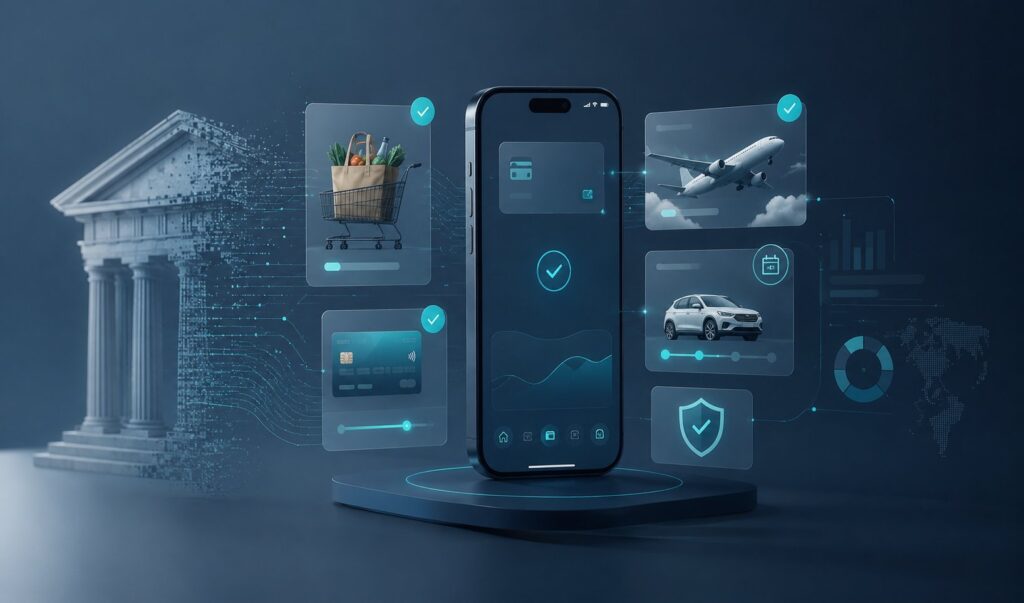
In Greek mythology, Hermes was the god who moved between worlds without anyone seeing him arrive: messenger of the gods, patron of merchants and, not by coincidence, of thieves too. His virtue wasn’t strength but discretion: he appeared exactly where he was needed, closed the deal, and vanished before anyone noticed his presence. Embedded finance — the trend redefining banking in Latin America today — has something of that nature. It’s the credit, insurance, or payment that shows up inside another experience, without asking permission or announcing itself: you pay in the corner grocery store’s app and you’ve already used a payment gateway with embedded credit; you buy a plane ticket and get offered insurance issued by an insurer you’ll never even name. The bank didn’t close down: it became Hermes.
In simple terms: embedded finance refers to financial services — payments, loans, insurance, accounts — integrated directly within a platform that isn’t a bank, such as an online store, a ride-hailing app, or a marketplace. The company that owns that platform doesn’t become a bank: it relies on the infrastructure of a fintech or financial institution working behind the scenes, invisible to the user. That way, the customer never leaves the app they were already in to request a loan, take out insurance, or pay in installments: it all happens right there, at the exact moment they need it.
The phenomenon is growing fast: the market in Latin America stands at around USD 38.8 billion and could surpass USD 50 billion by 2030. Brazil and Mexico lead the way; Argentina, Colombia, and Chile are advancing strongly. Behind those numbers lies a reversal of the question: companies stopped asking how do I get a loan from the bank? and started asking why don’t I offer it myself, at the exact moment my customer needs it?.
Like every gift from Hermes, this invisibility has both its bright side and its trap. The bright side: friction disappears, credit arrives when it’s needed rather than six weeks late, and a region where millions have historically been left outside the banking system finds a side door in. The trap: when the financial service dissolves into another experience, so does the clarity of who to turn to if something goes wrong. And credit that shows up at the exact moment of a purchase impulse can either meet a real need or manufacture one that didn’t exist.
The Greeks never mistook Hermes for a lesser god because of his stealth: they knew that moving something unseen demands more responsibility, not less. That, at its core, is the question still hanging over embedded banking: whether this new invisibility will be built with the same responsibility we once demanded when money still had a mailing address to send complaints to.


