

Artificial intelligence is reshaping banking operations and giving rise to a new professional profile: leaders capable of training, supervising, and orchestrating intelligent systems in real time.
What happens when technological theory meets the reality of a call center or a bank branch? Julián Colombo answered this question at the Fintech & AI Unconference Colombia 2026 by Finnovating. The CEO of N5 didn’t bring a typical corporate speech to Bogotá — he brought a blunt perspective: the era of 300-page manuals is over.
In a country that is becoming a FinTech benchmark in Latin America, N5 stood out for turning abstract concepts into tangible solutions. Through what they call ‘Sparring Mode’ and real customer simulations, the company demonstrated how banks in Argentina, Chile, and the United States are already using artificial intelligence (AI) to enhance every human interaction.
The core message was clear: in the future of banking, efficiency is not theoretical — it is trained with real-time data and led by the ‘Commander’ of algorithms.
From “Alt-Tab” to “Sparring Mode”: The New Banking School
One of the key highlights of the presentation was a critique of traditional training systems. Colombo recalled his early days in call centers three decades ago, where learning meant memorizing complex commands and keyboard shortcuts. The outcome was predictable: employees who struggled in their first months and negatively impacted customer relationships.
Today, N5 introduces ‘Sparring Mode’. With platforms already used by OpenBank (Santander Group), AI allows new executives to train using real conversations from the previous day.
Artificial intelligence allows you to practice anything with real conversations. Why does the customer have to be a real person if we already have yesterday’s interactions?
The Rise of the AI ‘Commander’
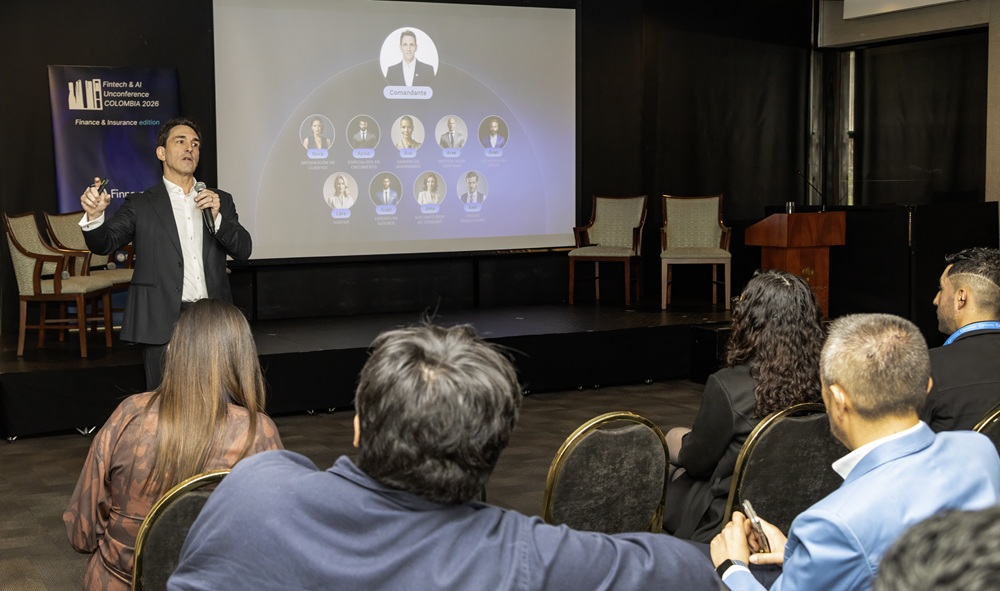
One of the most innovative ideas presented is the shift from traditional hierarchical structures to the ‘Commander’ model. Instead of replacing humans, AI enables the management of ‘swarms’ of specialized systems.
In this model, a single highly skilled professional oversees multiple AI agents:
- NOVA: focused on customer satisfaction (NPS)
- Apolo: focused on growth and customer acquisition
- Hunter: dedicated to active prospecting
This approach addresses one of the industry’s biggest challenges: the shortage of top talent. Instead of hiring dozens of experts, organizations can rely on one skilled ‘Commander’ to lead digital teams.
Still, limitations remain. Even the most advanced AI models have a hallucination rate of around 1.19%. In banking, even small errors can have serious consequences. That’s why the ‘Commander’ role is critical — monitoring performance, costs, and stepping in when needed.
Singularity and the Human Factor
Colombo also explored a deeper topic: Singularity. As AI evolves exponentially, it may surpass human capabilities in the future. However, in the near term (toward 2034), the focus is not on replacement but transformation — turning banking professionals into strategic leaders.
We are not a tech company. We are banking people building what we always wanted to have.


